How Much Does a House in Spain Cost in 2025? Honest Price Guide + Expert Tips
Automatically translated from Dutch. Read the original
A house in Spain costs around €250,000 on average, although this price varies widely depending on the location, size and condition of the property. The Costa del Sol in particular offers interesting investment opportunities, with apartments generating up to €30,000 a year in rental income. However, purchase prices there are also higher than the Spanish average.
In addition, buying a Spanish property involves various additional costs. On the Costa del Sol, transfer tax (ITP) on existing properties is 7%, and VAT on new-build is 10%.
Stamp duty is 1% to 1.5%, and a lawyer's fee is likewise 1% to 1.5% of the asking price of the property. Add notary fees, applying for NIE numbers and so on, and the real amount you will pay comes to roughly 10% to 11% of the purchase price for existing properties and 13% to 14% of the purchase price for new-build. Annual maintenance costs, in turn, can run to as much as 3% of the property's value.
In this comprehensive guide we cover every aspect of property prices on the Costa del Sol, from average prices per region to hidden costs and fixed charges. That way you get a clear picture of what a property in Spain really costs.
Average property prices in southern Spain in 2025
In 2025 the property market in southern Spain shows a clear upward trend. House prices continue to rise because of growing demand and limited supply in the most sought-after areas. This dynamic creates interesting differences between the various regions and property types.
Price differences between regions
The price differences between Spanish regions are remarkably large. In 2025, in Extremadura you can buy three 80-square-metre properties on average for the price of one comparable property in the Balearic Islands. With an average price of €307,801 for an 80-square-metre property, the latter region is among the most expensive areas in Spain.
There are also big differences within Andalusia. The Costa del Sol, particularly towns such as Marbella, Málaga and Estepona, is characterised by relatively higher prices, while the interior remains much more affordable. The province of Málaga, where the Costa del Sol is located, has an average price per square metre of €2,573 with an annual increase of around 9.4%, which makes the region ideal for investors interested in capital appreciation and rental income.
It is striking that certain coastal towns within the Costa del Sol are among the most expensive in all of Spain. Marbella, Benahavís and Istán are the most expensive municipalities in the region.
How much does a house in southern Spain cost on average?
The average property price across Spain for an 80-square-metre property is €178,735. In southern Spain, however, and on the Costa del Sol in particular, prices are higher.
In the province of Málaga you pay on average:
For an apartment: between €200,000 and €350,000, depending on the exact location and distance to the beach. Allow for renovation costs for apartments at the lower end of the price range. Prices can also rise to several million for penthouses, for example in projects with spacious terraces and a wide range of facilities.
For a townhouse: between €350,000 and €750,000. The same rule applies here.
For a detached villa: from €500,000, rising to several million in premium areas such as Marbella. For new-build villas, you should allow at least €1,000,000.
The widely varying prices are influenced mainly by factors such as proximity to the coast, amenities, infrastructure and appeal to international buyers. Demand from abroad remains an important driver of price increases, especially in tourist areas.
Price trends compared with previous years
The property market in southern Spain, particularly in the province of Málaga, shows a consistent rise. For 2025, an average price increase of 8% is expected for Spain as a whole. Some forecasts are slightly more conservative, such as that of CaixaBank, which predicts an increase of 4.1% for 2025, after a rise of 7.1% in 2024.
In 18 of the 19 autonomous regions, annual growth is accelerating or holding at the same level. Compared with a year ago, prices have risen by more than 3% in most regions. The strongest increases are recorded in Madrid (+4.8%), the Balearic Islands (+3.6%), the Comunidad Valenciana (+3.2%) and Catalonia (+3.0%).
On the Costa del Sol, price increases are even more significant. The province of Málaga recorded a year-on-year increase of 12.5%. This growth is fuelled by several factors:
Strong demand and insufficient supply
Rising construction costs
Growing demand from international buyers, who account for around 20% of all property transactions and on average have 70% more purchasing power than Spanish buyers
The enduring appeal of the Costa del Sol as a tourist destination
The upward trend in southern Spain is expected to continue throughout 2025, although with regional differences. Large cities and coastal areas will continue to see the fastest price rises, while inland areas show more moderate growth.
The property market in southern Spain therefore remains a dynamic area, offering both opportunities and challenges for potential buyers and investors.
What does a home on the Costa del Sol cost, region by region?
The Costa del Sol offers a wide variety of property prices, with each region having its own price level and appeal. Although the entire coastline remains popular with international buyers, there are significant differences between the various areas (according to data from Properstar).
Sotogrande and Manilva
In the far west of the Costa del Sol you will find Sotogrande and Manilva, areas that are becoming increasingly popular with buyers. Sotogrande is known as one of the most exclusive enclaves in Europe, where luxury villas and prestigious golf courses dominate the landscape.
Manilva is currently one of the most affordable areas on the Costa del Sol, with an average property price of €3,316/m². For apartments in Manilva, you pay an average of €2,844/m².
Sotogrande, by contrast, belongs to the upper segment, with prices rising rapidly because of the exclusive lifestyle this enclave offers. The proximity of prestigious golf courses such as Valderrama Golf Club and the marina of Sotogrande push prices up here. Houses cost around €3,469/m² and apartments €3,490/m².
Notably, Manilva is developing into a luxury destination. An investment group has bought 400 hectares with plans to transform it into “Europe’s top destination for luxury property”. This is likely to push prices up further in the coming years.
Estepona and Casares
Estepona saw an impressive price increase in 2024, bringing the average property price to €4,058/m² for houses and €4,189 for apartments.
There are also large price differences within Estepona itself. The most affordable areas are Playa Bahía Dorada and Costa Natura, while areas such as Benamara-Atalaya are considerably more expensive.
In Casares the average prices are €5,081/m² for houses and €4,021/m² for apartments
Marbella
Marbella remains the epicentre of luxury living on the Costa del Sol, with an average price of €6,191/m² for houses and €5,211/m² for apartments.
The housing market in Marbella underwent a fundamental change after the coronavirus pandemic, with an unprecedented wave of sales activity.
Mijas, Fuengirola, Benalmádena & Torremolinos
These municipalities offer an interesting mix of price levels:
| Municipality | Price per m² houses | Price per m² apartments |
| Torremolinos | € 3,184/m² | € 3,569/m² |
| Fuengirola | € 3,872/m² | € 4,162/m² |
| Mijas | € 3,749/m² | € 3,886/m² |
| Benalmádena | € 3,478/m² | € 4,330/m² |
Fuengirola and Torremolinos and their surroundings are undergoing continuous urban renewal, making them an attractive option with excellent value for money.
Málaga city
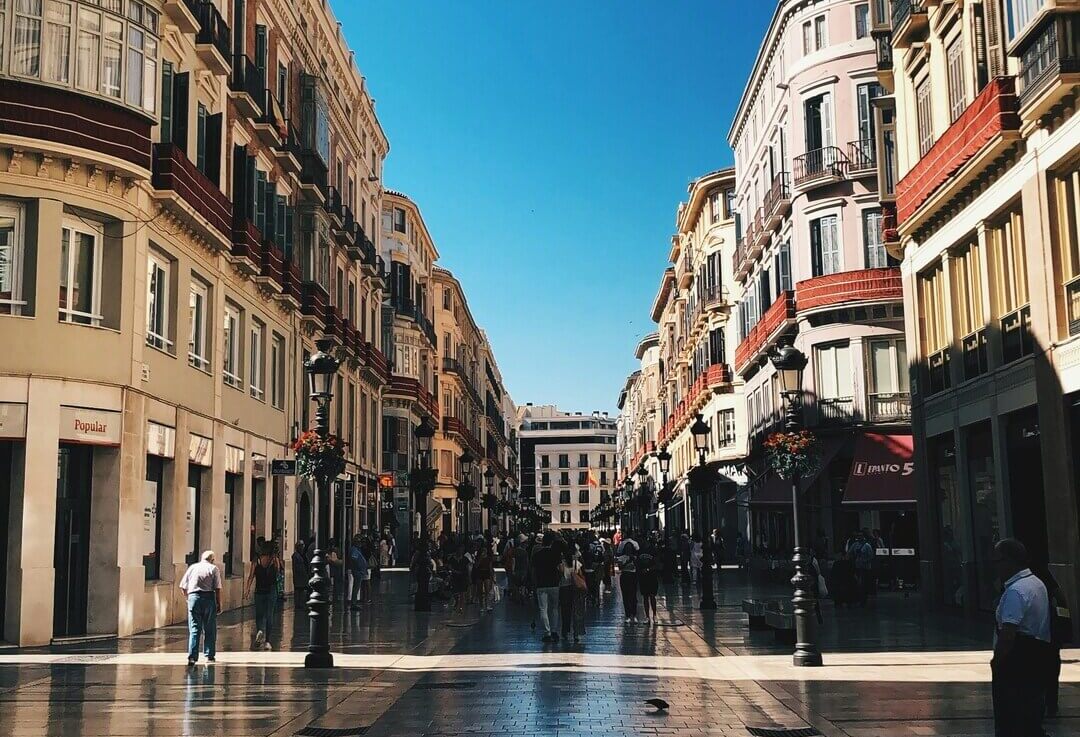
Málaga city continues to grow as a cultural hotspot and attracts all kinds of property buyers. The city offers a wide range of homes to suit different budgets and lifestyles. Calle Larios (Málaga’s main shopping street), for example, is among the most expensive in all of Spain.
The average price for houses is €3,650/m² and for apartments € 4,087/m². Although Málaga is not the cheapest option, it offers an attractive alternative to cities such as Madrid and Barcelona.
New-build prices and VAT in Spain explained
Buying a new-build home in Spain involves various taxes and costs that significantly affect the total investment. The tax system for property differs substantially between new-build and existing homes, which has a direct impact on your purchase budget.
What is included in the purchase price?
When developers advertise new-build homes in Spain, the price shown usually covers only the basic property itself. In new-build projects on the Costa del Sol, homes are often sold in different levels of finish. The purchase price usually includes:
The property itself with standard finishes
Communal facilities such as swimming pools and gardens
Parking space and storage room (priced separately in some cases)
However, these purchase prices are exclusive of taxes and additional costs. In 2025, new-build prices are expected to rise by 4% to 5%, following an average increase of 8% in 2024. Since 2015, new-build prices have risen by as much as 89%. The prospect of further price rises makes the region ideal for investors.
Moreover, new-build homes in Spain are considerably more expensive than existing properties. According to recent figures from the valuation firm Tinsa, new builds cost an average of 44% more than existing homes. The average price of a new-build home in Spain is €2,617 per square metre, whereas an existing home costs an average of €1,818 per square metre. Bear in mind, however, that these prices also include dilapidated buildings and properties occupied by squatters. In reality, you may therefore end up spending more money making an existing property liveable/habitable than you would on a new build.
13% VAT and additional purchase costs
Unlike existing properties, new builds are not subject to transfer tax (ITP) but to VAT (IVA). The costs for a new build consist of:
VAT (IVA): 10% of the purchase price on the mainland. This is considerably lower than the 21% VAT charged in the Netherlands or Belgium. In the Canary Islands, this rate is as low as 7%.
Stamp duty (AJD): Between 1.2% and 1.5%, depending on the location. In Andalusia, it is 1.2%.
Notary fees: Approximately 0.5% to 1% of the purchase price.
Land registry fees: For registration in the official land registry, ranging from €400 to €700.
Legal fees for a lawyer/solicitor: If you engage a lawyer, you will pay around 1% to 1.5% of the purchase price in fees, with a minimum of €2,500. A lawyer can, however, save you a whole range of costs and headaches by carrying out thorough research into the property you are buying.
In total, when buying a new-build home you should allow for approximately 13% to 14% in additional costs on top of the purchase price. These percentages may vary slightly depending on the specific region and property. It is important to know that this tax structure appears set to remain stable in the short term.
Difference between new-build and existing properties
The choice between a new build and an existing property has significant financial implications. Firstly, there is a clear price difference: new-build homes are on average 44% more expensive than existing homes (although the price difference is often very noticeable in the other direction too, think of necessary renovation costs, occupation by squatters, etc.). In Andalusia, the difference averages around 38%.
There is also a difference in tax structure:
New build: 10% VAT + 1.2% to 2% stamp duty and administrative + notary costs
Existing properties: 6% to 10% transfer tax (ITP), depending on the region. 7% in Andalusia.
Besides the financial differences, new builds offer advantages such as modern amenities, energy-efficient systems, flexibility during the design process and construction guarantees. On the other hand, existing properties have their own advantages, such as immediate availability, established locations and often more room for negotiation.
Hidden costs when buying a home in Spain
In addition to the visible purchase price of a Spanish property, there are various hidden costs that buyers often overlook. For a clear financial overview, it is essential to factor in these costs in advance. Possible costs may include:
- Stamp duty (1% to 1.5% depending on the location)
- Notary fees
- Land registry fees
- NIE numbers or CIF/NIF numbers
- Gestoria (office that handles the documentation)
- Administration fees
- Setting up utility contracts and direct debits
- Legal fees for a lawyer/solicitor (1% to 1.5% of the purchase price, minimum of €2,500)
Lawyer and translations
Unlike in the Netherlands and Belgium, a lawyer is indispensable in Spain when buying a home. Whereas the notary has only a limited role, the lawyer carries out most of the legal work.
A lawyer usually charges a fee of 1% to 1.5% of the purchase price, with a minimum rate of €2,500 excluding VAT. This fee covers various essential services:
Checking the property to be purchased for ownership status, outstanding debts and legality
Drafting and reviewing contracts
Acting as the point of contact with the seller (together with the estate agent)
Overseeing the payment process
Assisting with the transfer of ownership at the notary
Registration of the deed of purchase
Payment of the relevant taxes
Transferring utility contracts into your name
In addition, the lawyer checks whether there are any debts attached to the property. This is crucial in Spain, where debts remain linked to the property and not to the previous owner. Outstanding electricity and water bills, taxes or mortgages remain attached to the property if the lawyer does not deduct them from the purchase price.
NIE number and land registry costs
Every foreigner who buys a property in Spain must have a NIE number (Número de Identificación de Extranjeros). This tax identification number is required for:
Registering property with the land registry
Opening bank accounts
Setting up utilities
Taking out insurance
Filing tax returns
The costs of applying for a NIE number in Spain vary depending on how you apply:
1. Applying yourself at the Spanish police (in Spain)
- Costs: approximately €10 to €15 (official administration fee, via form Modelo 790, code 012).
- You need to book an appointment at a police station with an extranjería (foreigners' office) department and complete the application form.
2. Applying via the Spanish embassy or consulate in Belgium or the Netherlands
- Costs: approximately €10 to €15, comparable to Spain.
- Allow for a longer waiting time and more paperwork.
3. Having it arranged by a gestoría or lawyer in Spain
- Costs: between €100 and €250, depending on the service provider.
- They take care of the application, the paperwork and often the appointment for you.
- The most attractive option if you are short on time.
Furnishing costs
Furnishing your new home is an important step that you should not underestimate. Creating a comfortable and functional living space can range from choosing furniture to landscaping the garden. Do not forget to take into account local styles and materials that suit the Spanish climate and culture. Here too, the costs can vary greatly: how big is your home, is there a terrace, will you opt for quality furniture, will you do everything yourself or have the home furnished including installation, …
If you are looking for a personalised approach from A to Z with quality furniture, you can turn to HOMEINSPAIN >
Fixed costs after buying a property
After buying a property in Spain, various fixed costs follow that owners have to pay every year. These costs vary by region and type of property, but they make up an important part of the overall cost picture.
IBI and refuse tax
The IBI (Impuesto sobre Bienes Inmuebles) is an annual property tax that all property owners must pay. The rate varies between 0.4% and 1.1% of the cadastral value, depending on the municipality. On the Costa del Sol, this tax is usually between €300 and €1,000 per year.
Homeowners also pay an annual refuse tax (Tasa de Basura). This tax covers the costs of waste collection, transport and recycling. The amount varies by municipality and type of property, with average annual costs of €50-€100 for apartments and €80-€150 for houses. Other sources mention amounts between €120 and €200 per year.
Insurance and utilities
Home insurance is not a legal requirement (in some cases), but it is strongly recommended. Buildings insurance costs an average of €300-€500 per year and usually covers fire, water damage, liability and burglary. According to the Organisation of Consumers and Users, the average cost of basic insurance is around €250 per year for a 120 m² home. Most people insure their home through their bank.
For utilities, you need to allow for electricity, water and any gas costs. A typical water bill is around €50 per quarter, plus fixed charges of around €25. Electricity costs vary considerably but average €8 per square metre per year, which comes to around €800 annually for a 100 m² home.
Community fees for apartments
Apartment owners pay “gastos de comunidad” every month for the maintenance of shared facilities. These costs are set by the owners' association and divided on the basis of the share rule (cuota de participación), under which larger apartments pay proportionally more.
The community costs cover:
Maintenance of communal areas, swimming pools and gardens
Cleaning and electricity for communal areas
Lift maintenance and repairs
Security and concierge services
Depending on the facilities, the costs usually range from €30 to €150 per month. For a complex with a swimming pool but no lift, you pay an average of €50 per month, while complexes with a lift, swimming pool and gardens cost around €100 per month. For luxury urbanisations with additional facilities such as heated swimming pools, padel or tennis courts and fitness rooms, the costs can rise to hundreds of euros per month or more. A good rule of thumb for estimating the monthly communal costs in a project with a swimming pool, gym and so on is the purchase price divided by 1,000.
Costs if you rent out the property or leave it empty
Owners of Spanish holiday homes face specific taxes and obligations, whether they rent out their property or leave it empty. These costs are an important consideration when budgeting for a holiday home in Spain.
Tourist tax and licences
To rent out a property to tourists, a rental licence (“licencia de alquiler turístico”) is legally required. Without this licence, you risk heavy fines and a three-year ban on letting. The requirements vary by region, but generally include fire extinguishers, smoke detectors, first aid kits and evacuation plans.
Licences are valid for 5 years, and properties must be equipped with internet, air conditioning, heating and a first aid kit. In addition, as of 3 April 2025, prior approval from the owners’ association is required for short-term lets in apartment complexes. In large city centres on the Costa del Sol, such as Málaga and Fuengirola, rental licences for tourist lets are often no longer issued. Here, only long-term rentals or lets to non-tourists are possible.
Non-resident tax
Non-residents must pay tax annually using the “Modelo 210” form:
If the property is let: 19% tax on net rental income (for EU residents) or 24% (for non-EU residents)
If the property is not let: 19% on 1.1% of the cadastral value (imputed income)
This tax is personal — if there are several owners, each individual must file a separate return. If the property is let, a return must be filed every quarter, whereas if it is not let, a single annual return is sufficient. Direct costs such as insurance, refuse tax and commissions are deductible.
Costs for vacant properties or seasonal use
New regulations allow municipalities to impose economic sanctions on owners of vacant properties. A property is considered vacant if it has stood empty for more than two years without interruption. Municipalities may impose a surcharge on the IBI tax:
50% surcharge for properties that have been vacant for two years
100% for properties that have been vacant for more than three years
Up to 150% for owners with two or more properties in the same municipality
Please note: this is not automatic. Each municipality must introduce it itself through a council resolution.
Even when a property is vacant, there are costs for utilities (€40-50) and communal costs for apartments (€50-100 per month). In addition, owners who let their property must register guests with the Spanish Ministry of the Interior within 24 hours.
Conclusion: property costs in Spain 2025
Anyone who wants to buy a property in southern Spain should therefore not only consider the listed base price when setting their budget, but also VAT and additional legal and administrative costs. Furnishing and fixed (ongoing) costs are also important. You may well be able to afford a large home or an apartment in a project with numerous facilities, but can and do you want to bear the monthly costs that come with it? So weigh up carefully for yourself what you want to spend in total on the purchase and furnishing, all-inclusive, and what you expect to be able to pay each month in fixed costs afterwards.